Update: August 23, 2026
BURBANK AIRPORT ISSUES AND HOW THEY AFFECT OUR COMMUNITIES
In 2019, members of Sherman Oaks & Encino for Quiet Skies (SOEQS) and its partner organizations began advocating for historical departure routes to be reinstated at Van Nuys Airport (VNY) after the FAA suddenly shifted hundreds of low flying jets over the high Fire Hazard Severity Zones (FHSZ) of the Santa Monica Mountains and foothills, impacting the safety of hundreds of thousands of residents, and large areas of noise-sensitive and environmentally-protected open spaces. In 2025, in collaboration with representatives of the Noise Task Force and LAWA, the FAA returned to departure turns over the Sepulveda Basin. More information is in the February 21, 2025 post below.
Other community groups that focus on Burbank Airport (BUR) have continued to address BUR flight paths and the BUR terminal expansion, officially opening October 2026. This post is about some of those issues that our communities face:
1. The Operational Reality: The "Efficiency Loophole"
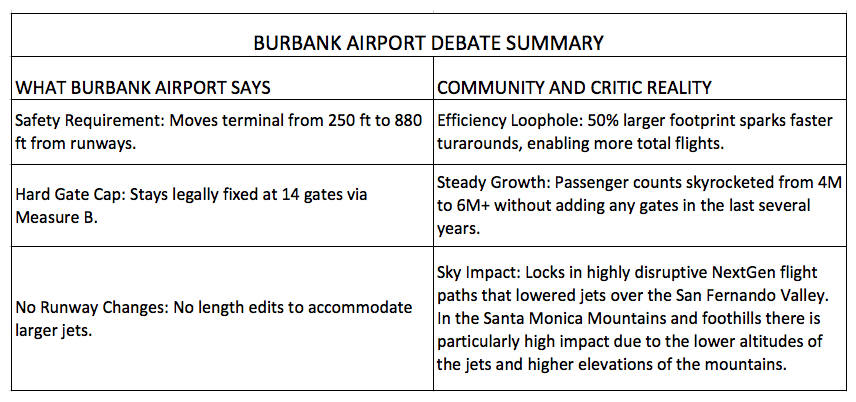
BUR airport points to a strict 14-gate limit mandated by local law (Measure B). However, critics and aviation watchdogs note that gates do not equal capacity. The 1930s-era terminal acted as a physical choke point due to crammed TSA lines, outdoor ticketing overflows, and slow baggage systems. [1]
By building a new facility that is 50% larger internally (355,000 square feet), the airport removes these bottlenecks. Streamlined infrastructure allows airlines to turn flights around much faster, meaning the same 14 gates can process significantly more planes and passengers per day. [1]
2. Historical Proof of Growth
The skepticism of neighborhood groups is backed by historical data. The airport has already proven it can grow rapidly without changing its physical footprint. Passenger volume grew from roughly 4.1 million annual travelers in 2016 to over 6 million in recent years, demonstrating that intense, continuous capacity expansion can happen purely through scheduling efficiency. [1]
3. Shifting Flight Paths & NextGen Noise
A core driver of local issues are that the terminal replacement coincides with major changes in the sky. In 2016–2017, the FAA rolled out its NextGen satellite navigation system, which significantly altered departing flight paths. [1]
Instead of traditional wider turns, planes were concentrated into narrow, lower-altitude paths directly over communities from Toluca Lake, south into the Santa Monica Mountains through Studio City, Sherman Oaks, Encino, and parts of Bel Air—the same areas that have been impacted by VNY. The high elevations in the mountains and foothills are doubly impacted by the jets’ lower altitudes. Community advocates believe the new terminal is designed to seamlessly absorb and lock in the high-frequency traffic demand generated by these aggressive federal flight paths. [1, 2, 3, 4]
For more information about the FAA’s BUR departures and the new BUR terminal expansion, and how it affects neighborhoods across the San Fernando Valley, please visit the websites of the community groups focused on this issue: Studio City for Quiet Skies and UproarLA.